I was lucky to attend two Rare Disease Genetic conferences near the end of last year. Some of you are yawning, I can almost see it! But try to stay with me and hear me out, as these were deeply compelling experiences. So much came from both conferences in terms of those speaking at the podium to the equally amazing individuals in attendance I was so fortunate to meet. I may have to write about these layered experiences in installments as they were vast and ran deep.
The topic of this fall’s conference was Improving Health Care Experiences in the Rare Disease Community and I love that chosen title. It serves as a gentle reminder that while the list of rare diseases is vast, individually we can feel like and are, a healthcare minority. There’s nuances to Sanfilippo alone that I’m still learning, and I am fortunate to have a community of resources through social media and long standing friendships for vetting inquiries. But what if you were a health care worker who has never seen a particular syndrome? There is no way to know the myriad of factors that can take even a parent, fully invested 24/7, years to understand. So what if you were to treat dozens of rare diseases over the course of your profession that you had never seen before. Double that with the limited resources of practicing somewhere rural and one can see the benefit of these conferences.
Both events, one in October and one in December, were well rounded, and I did not overlook the fact that the Executive Directors of both non-profits hosting these events were Registered Nurses. Inspiring! Attendees enjoyed an interactive session with a Rare Disease Legislation Advocate who imparted education on how to lobby locally and beyond for rare disease legislation. Then came the medical heavies – geneticists speaking to telehealth and the potentially risky uptick in “DIY” genetic testing. I learned so much from the geneticist giving a deep dive into the phases of clinical trials and from the attorney who, as a single Mom to a daughter with a rare disease, chose to create the advocacy resource group she felt was much needed in her home state. She spoke to the early years of her child’s diagnosis when she had so little to work with and so few were able to help her navigate an already overly demanded system. You could hear the air leave the room when she shared with us that her daughter had passed away since her last public speaking engagement. I remain awe struck by the continuous examples I see of parents who do not close the door to their mission even when the unfathomable occurs.
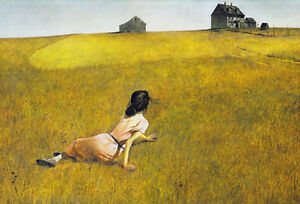
And then, something happened. For those who may recall my Simple Sketch blog, a similar episode unfolded when a research geneticist came to the podium and prepared his slides, with the cover image being a painting that I know well. Andrew Wyeth’s Christina’s World. Some members in my family particularly love this painting, and one of my brothers has a large print framed in his living room. We see a dark haired young adult, perhaps a child, sitting in a pale pink shirt dress in a seemingly endless field of muted grass. She is looking off in the distance at a large, almost gloomy yet strikingly beautiful home at the edge of the field.
After learning about thismost interesting scientist speaking at the podium, how he studies mutations in mice and can be commissioned to create mutations for private study while working from his beautiful lab overlooking the ocean in Maine, he came back to the image of Christina’s World. He asked the audience what we saw. How old was this girl? Was this her own home she was looking at from afar? Is she healthy, so to speak? He explained that little was known about this image, but it was thought that Christina was the neighbor to the painter Wyeth. As the story goes he would see her crawling through the endless grass from her homestead to, do what exactly? Escape? Feel freedom? Experience autonomy? To simply…breathe?
It was thought for years by Art Historians that Christina suffered from polio, and in recent years it has been suggested that instead, she had the genetic condition Charcot–Marie–Tooth disease. This is a degenerative condition where the muscles, most often in the arms and legs, weaken as a form of motor and sensory neuropathy takes hold. I reflected on Christina, wondering how long, in terms of time, was her journey to this destination? Where was her family? Did she have caregivers? Did she attend school? It has been said that Wyeth would watch her from his own window next door and likely wondered some of these questions too. It struck me.
On New Years morning, at my insistence, Mike and I always write our goals for the upcoming year. I then take our lists and fold them into the tiniest bits of paper and stuff them far back in some random desk drawer and pusporsely forget all about them. We then pull the lists out and unfold them one year later, marveling at how often each goal comes true.
This year on New Years Morning, surprising even myself, I posed a similar yet different question. Instead of asking about goals and objectives for 2020 I simply asked, “what are your hopes and dreams”? Mike looked at me like I had two heads. We are so goal and task oriented in this culture that we often stop thinking this way once we exit our teens or twenties. “What are your hopes and dreams”? We had no clue. We both sat there dumfounded, our heads spinning. We still joke about that moment but continue to ponder the question both in jest and in sincerity.
In that same vein, I keep thinking about Christina…what were her hopes and dreams in the moment of this painting? And then of course I think of Sasha. What are hers? We all have them, and its inspiring when art and science merge to remind us why.
- To read a bit more about Christina’s World you can click here: https://www.moma.org/collection/works/78455
 Folding Origami for God